
NON-GOVERNMENTAL ORGANIZATION


CSI presented human rights issues in Armenia to the UN
“In course of 5 years the law enforcement bodies were not able
to investigate the ten murders committed on March 1, 2008 because they have been looking for perpetrators among
demonstrators and cannot identify them whereas they did not even try to look
for perpetrators among police officers though we are fully aware that some of
them were killed as a result of misuse of special means”, says CSI President
Arman Danielyan.
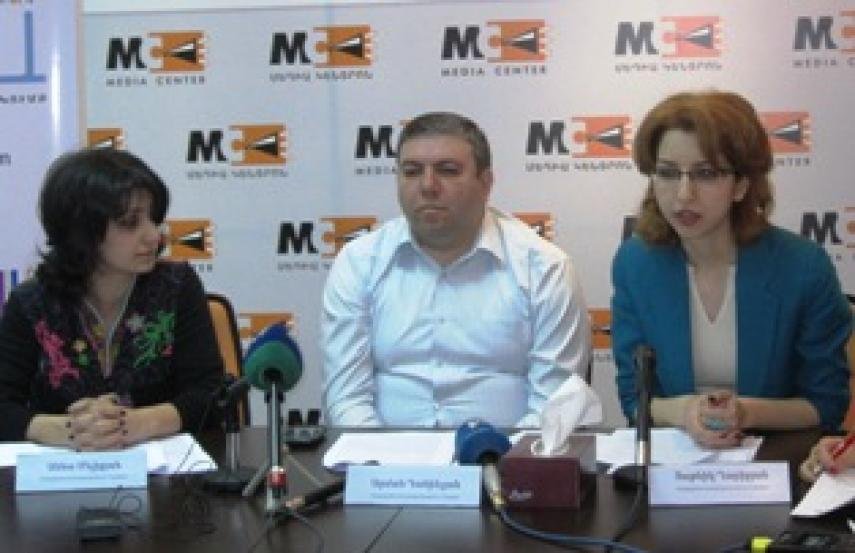
On April 3, Civil Society Institute’s (CSI) President
and lawyers talked about human rights issues at Media Center.
Every four years Armenia submits to the UN Human
Rights Council Universal Periodic Review (UPR) on the human rights situation in
the country. The country’s UPR report has been submitted in 2010 and 166 recommendations
were received from the UN member states.
Recently Armenia has submitted the Interim Implementation
Report for the period from May 2010 to December 2012. As a result, out of all received
and accepted recommendations 43 recommendations were considered implemented, 78
have been partially implemented and 42 considered not implemented so far.
At UPR review, Armenia did not accept the following
recommendations: eliminating discrimination against Yezids, defining
discrimination against women on the legislative level, terminating politically
motivated persecutions, ensuring the right to peaceful assemblies.
Three organizations submitted the Alternative Interim
Report
Along with the Interim report submitted by Armenia,
Civil Society Institute (CSI) in cooperation with the Norwegian Helsinki
Committee (NHC) and International Federation for Human Rights (FIDH) presented
to the UN Human Rights Council the Alternative Interim Report for the same
reporting period.
CSI lawyer Tatevik Gharibyan stressed out that they
referred to the human rights issues of those sectors where they were specialized
and made recommendations on improvements.
“The judiciary
is not independent yet, courts demonstrate prosecutorial bias, the principles
of equality of arms and presumption of innocence are violated.”
Situation with torture continues to raise concerns.
Definition of torture does not comply with the definition in the UN Convention
against Torture; victims often do not speak about fearing that their situation
could be worsened. Even if they lodge complaints, no effective and impartial
investigation is conducted.
The penitentiary institutions (PI) continue to be
overcrowded. The living conditions may be evaluated as poor. There are no
rehabilitation programs for inmates.
There is a need for juvenile justice reform.
Prosecutors, investigators and defense lawyers who are involved in cases of
juveniles must be specialized. The number of alternative not-custodial
punishments should be increased”, briefly presented the report the lawyer.
Torture
According to the Alternative report, there is no
significant progress made in the field of torture prevention in Armenia.
According to CSI lawyer Anna Melikyan, Armenia still
has not fulfilled commitments: definition of torture has still
not been brought into compliance with the United Nations Convention against Torture;
police stations are still closed for the public monitoring group.
“The serious issue is that torture is accepted as a
mean for obtaining confession and investigating criminal case”,- expresses
concerns Tatevik Gharibyan and reminds of the Misha Harutyunyan’s case who was
tortured with the aim of extracting self-incriminating testimony; the court
accepted this testimony with argumentation that the torture had been applied
with the aim of establishing the truth.
On the other hand, lawyers believe that there is a
conflict of interests because the staff member of the body which is responsible
for applying torture also conducts the investigation into torture allegations.
“We have
highlighted in the report that prosecutor’s powers are conflicting in this
field. On the one hand the same prosecutor implements the oversight of the
lawfulness of investigation, approves the indictment and pursuing charges in
court. Apparently there is a conflict of interests. If the testimony has been obtained
illegally through torture, the prosecutor is deprived of the main evidence and
cannot efficiently defend charges in court”, says Anna Melikyan.
Issues in the penitentiary system are numerous
and have deep roots
CSI President Arman Danielyan believes that there is
no progress made in the penitentiary system and the problems are numerous and
have deep roots.
«The Ministry of Justice pledges that new penitentiary
institutions will be built in the frames of carried our reforms and everything
will be settled. We have been hearing these pledges for 10 years and do not
have expectations that new PIs will be built in the nearest future. Even if
they build new PIs, the issues have deeper roots», he says.
The human rights defender indicates a number of
problems which are not connected to the material conditions.
There is a lack of efficient complaints procedures for
inmates who are kept in PIs against the actions of the penitentiary service.
That leads to the protests and complaints by means of self-harming.
Another issue of concerns is the interrelation between
the Ministry of Justice and the Penitentiary Department.
«According to our assessment, today the Penitentiary Department does not
take into account the position and opinion of the Minister of Justice because the
Head of the Department is assigned by the President of Armenia directly and the
Head of the Penitentiary Department assumes to be on equal footing with the
Minister. The Minister should supervise the Head of the Penitentiary Department
but the Minster is not entitled to dismiss the Head and the supervision depends
on personalities. We think it is wrong », - says Arman Danielyan.
He believes that the penitentiary system is more closed
now than it was 10 years ago: the Head of the Penitentiary Department does not
give any interviews; access to the PIs for journalists is strictly limited
which in human rights defender's opinion does not contribute to the
transparency and oversight over the system.
The investigation into March 1 case has not revealed the murders for 5
years
The UN recommended conducting effective investigation
into 10 deaths following the events of 1 March 2008, revealing perpetrators and
providing with redress the families of victims. That has not been implemented so
far.
CSI President Arman Danielyan highlights that for 5
years the Special Investigation Service was not able to reveal the crime that
was committed in the presence of numerous law-enforcement officials.
He emphasized the fact that the criminal case was
instituted under part 2(10.1) of Article 104 of the Armenian Criminal Code -
murder committed during mass disorders by its participants.
«It is assumed that the police officers are not
considered participants of the mass disorders and consequently murderers are
sought among the protestors and cannot be found. They haven’t even tried to
look for and find perpetrators among police officers in the recent years though
we know that some people were killed as a result of misuse of special means»,
stresses out Arman Danielyan and suggests the SIS to pay attention to the
actions of law-enforcement bodies. «Maybe then perpetrators will be found»
In response to a question of journalists what measures
could be taken in case Armenia fails to implement its commitments, CSI
President told that the UN lacks sanctions and binding procedures.
«Armenia undertook these commitments and pledges
voluntarily and our objective is not to demand to take sanctions against
Armenia. We have to be consistent and compel the government to fulfill its
obligations or give solutions to existing problems in the country», told Arman
Danielyan and reminded that Armenia still has time to implement the
recommendations until the next UPR in 2 years.
Source Url: