
NON-GOVERNMENTAL ORGANIZATION


Civil Society 2.0
Samvel Martirosyan
Civil society of independent Armenia marks its 20th anniversary. Though we might say it has a longer history than officially registered independent Republic of Armenia. Civil society of soviet era could exist only in prison cells and colonies. However, Karabakh movement of 1988-91 led to the vigorous development of civic movement. Civil society has developed then without being an adjunct to something else, as a part of society, it became a dynamic front of the struggle for civil rights.
Later in 1991 when the state was just formed from the most important perspective of civil rights, the conflict with neighbouring country turned to real large-scale war. Naturally, it was hard to speak about the civil society during the war. Limitation of freedoms during the war was logical and constitutional. Serious perception of freedoms during the first years of postwar period was not realistic either: the country was flooded with weapons; the field commanders were sharing the marzes (regions) with each other. Meantime, civil and political realms were separated and number of political leaders formed the core of civil society.
During the next years civil society of Armenia was obtaining a new shape. Somehow in the same way were developed societies in post soviet western counties (leaving aside Central Asian countries, where the development destroyed remnants of civil society). The main scenario was as follows: civil activity was mainly focused in NGO sector and was funded by a number of donor organizations. This was quite acceptable during the complicated years when it was barely possible to imagine struggle for rights and freedoms differently.
However, when this situation lasted years, civil society somehow was equated to the NGO sector, whereas the NGOs, as Lenin said, became distant from people. In recent years this distance increased even more and led to the situation when a significant part of society started to perceive NGOs as enemy (of course, different revolutions and Russian propaganda which presented the whole NGO sector as a fifth column contributed to this).
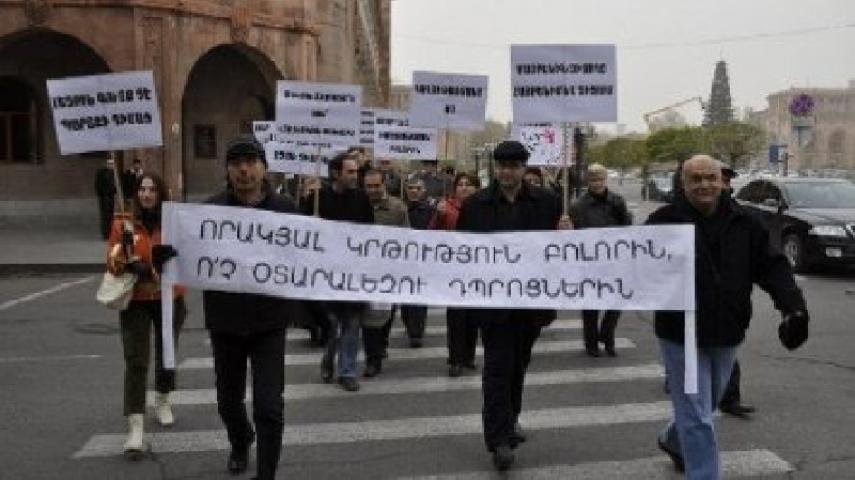
The situation has drastically changed when the social media (social networks, blogs etc) gained a scope in Armenia. They stopped to be purely virtual and they started to play a role in real life. Early spring of 2010 marked the creation of the "civil society 2.0". These days several virtual groups simultaneously turned to the real civil movements. Of course, there were similar attempts before and part of them achieved certain goals in reality. However, in the beginning of 2010 groups were created that changed the social sphere in general. One of the pioneer groups was movement for the protection of summer hall of Moscow cinema-house, the other movement was against the reopening of the foreign language schools. Besides, one of the first likewise movements were groups created by the environmentalists focusing their efforts to solve problems of Teghut forest, green zones problem of Yerevan etc. Another group was involved with the protection of pregnant women's rights. Essential was that NGOs also involved in this movement and supported inexperienced activists with organizational skills. It is important to understand that NGOs and media had their valuable contribution to creation and strengthening of the social activism.
These groups have fostered new types of civil movements which are special because people with different or even opponent political and social views are unified based merely on the social interest and aspiration to solve certain issue. As a matter of fact, today there is a new networking civil society established and it has started to become closer to the "traditional" civil society.
Photo: iranahayer.com
Source: www.hra.am