
NON-GOVERNMENTAL ORGANIZATION


Resembling ''the Case of the Seven''
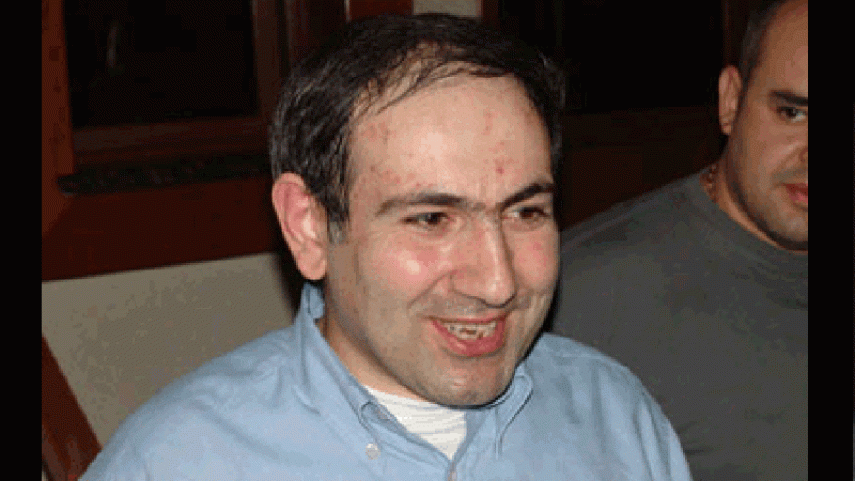
Today the court of first instance of Shengavit is starting the hearing of the case of the editor-in-chief of ''Haykakan Zhamanak'', Nikol Pashinyan. This court came to be better known to the public after March 1 events and the riotous case (known as ''the case of the seven'') against the oppositional activists. The hearings are held in adjusted court-rooms, separated from the court by a thick glass-wall, which creates tense and rather unfavorable working conditions for journalists, the audience has to follow the session through the glass, while the journalists follow by the monitors installed in a special room.
All in all, the case resembles ''the case of the seven''. Here again, Mnatsakan Martirosyan and Koryun Piloyan are appointed a judge and a prosecutor respectively and again they have aroused negative public sentiments. As for the fair trail, in this case there is no positive feeling as well. Pashinyan's attorney Lusineh Sahakyan sees an intention here.
''Maybe a trial is expected that will arouse interest among people. In my opinion Mnatsakan Martirosyan has no right to conduct this case. He has already shown by the concluded acts that he cannot conduct an objective and thorough case. His juridical acts on innocent people already show that he didn't conclude the cases impartially.
The judge has appointed the trial with various violations of law, limiting the period of motions. When accepting the case for the hearing Mnatsakan Martirosyan didn't define the term when the defending side could submit motions. Till the defending side has submitted a motion to terminate the case, it turned out that the decision to start the hearing had already been taken.
The contents of the materials of the criminal case comprising of 13 volumes are the repetition of the publicly known 'case of the seven'. That is why we don't hope for a fair trial'', says Lusineh Sahakyan,'' besides, it is not mentioned exactly what actions Nikol Pashinyan has taken. Thus, what refers to my defendant, the charge has not been explained and clarified''.
The attorney also stated that in any case it would be difficult for the court, with such kind of a charge and complete absence of evidence to impose punishment against Nikol Pashinyan, in which case amnesty will not apply, and he won't be released from the court-room.
''Otherwise, it will mean to hold hostage a man for his views and believes'', claims the attorney.
The editor of the ''Haykakan Zhamanak'' is accused under the first part of Article 225 of the criminal code; organizing mass riots, and under the first part of Article 316; use of violence against officials.
The strictest punishment defined by the above mentioned articles is a sentence of 10 year imprisonment.
Nikol Pashinyan who had been under investigation after the events of March 1-2, 2008, voluntarily appeared to the official bodies on June 1 of the same year and the court reaffirmed the decision of the year of 2008 to choose detention as a preventive measure.
Zhanna Alexanyan