
NON-GOVERNMENTAL ORGANIZATION


The Corruption rates have not declined in Armenia
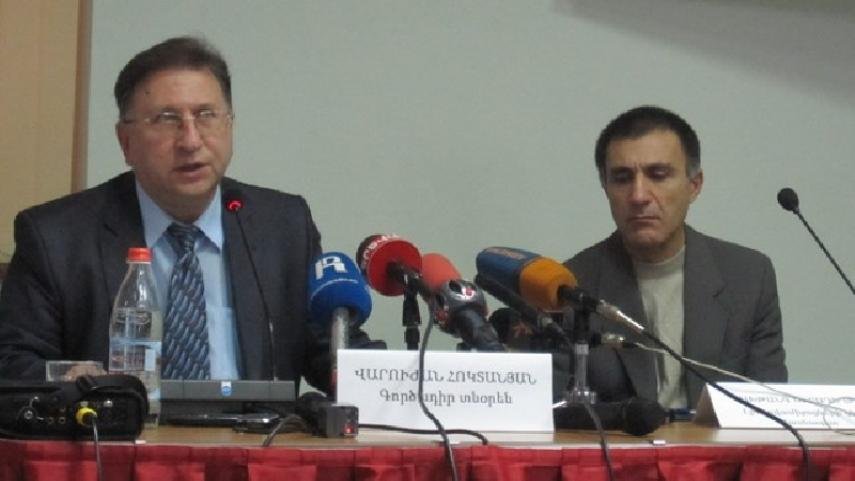
The corruption rates in Armenia have neither increased nor declined as compared with the last year: this was stated by the executive director of TI Anticorruption Center Varujan Hoktanyan.
The index of Armenia is 2.6, as it was last year: this is one of the worst indicators in the 0-10 scale. This year 182 countries were examined, and Armenia ranks 123rd among these countries.
Corruption has not declined in our country, but if we compare with the data of 2007, we observe slow decrease. When compared with 2003, when the index was 3, the reduction becomes more obvious.
It should be mentioned, however, that index doesn't include corruption in private sector. It includes only the public sector and the governmental bodies.
Hoktanyan also reminds that corruption doesn't necessarily mean bribery: the squandering of state's funds, looting of the budget, cases when banks are bribed to give loans and then they do not demand money back, which causes crises like the one in 2008, all these factors also form corruption.
"There are only 49 countries out of 180, where the index is higher than 5 points. Empirical studies show that it is normal, when the index is 5 or higher", says Varujan Hoktanyan.
Armenia is quite far from this index, unlike the countries, which compared with the last year, advanced in the scale. Such countries that recorded advancement are Norway, Taiwan, Rwanda, Georgia, Chad. Haiti and Oman recorded decline as compared with last year.
Hoktanyan says that the whole map can be drawn with red, since the greater part of the world is corrupted. Even in those countries, which boast having democracy, corruption does exist. These are Syria, Libya, Greece and Italy.
Hoktanyan doesn't believe that in Armenia it can be possible to learn about corruption cases in a closed room and ensure the secrecy of the source.
"In countries like Singapore, Honk-Kong and in some European countries this method fostered the reduction of corruption. In our case, our country has an international responsibility to insert such mechanisms, but my approach is not optimistic towards this method, since we have systemic corruption, and the person who will give information, can risk seriously, and it is not even excluded that it will be used for political reckoning", stated Hoktanyan.
According to Hoktanyan, changes in legislation will not bring much difference, if there won't be governmental will: "Ending with corruption is like ending with smoking, both demand will".
"Also the corruption crimes should be punished not simply for demonstration, but consistently. I suggest imprisoning the ones who are guilty, but on the other hand, there should be consequences, so that the citizens see the result and do not think that this was a political reckoning for example", says Hoktanyan.
During the elections the corruption rates raise and according to Hoktanyan this is the worst situation, because political corruption reaches very high levels: abuse of administrative resources, voting bribery, etc.
Corruption exists in the educational sphere as well. According to the research of Caucasus Research Resource Center fulfilled last year, educational sphere in Armenia was the most corrupted sphere.
Despite the fact that during several years our country realizes lots of anticorruption projects, there is little change and the corruption rates do not go down in Armenia.
Karine Ionessyan
Source: www.hra.am