
NON-GOVERNMENTAL ORGANIZATION


Responsibility to Protect: Prevention or Intervention?
All states are obliged to protect their population from mass violence, ethnic cleansing and genocide. If they fail to do it, international community must react and help. If in this case the problem remains unsolved, international community should intervene.
These three pillars form the basis of UN Norm of 2005 on "Responsibility to Protect (or R2P)", the aim of which is to prevent crimes against humanity and to protect the peaceful population.
This norm was approved by Republic of Armenia. Meanwhile, surveys fulfilled by UN Armenian Association among politicians, scientists, NGOs and media showed that awareness level on R2P norm is quite low.
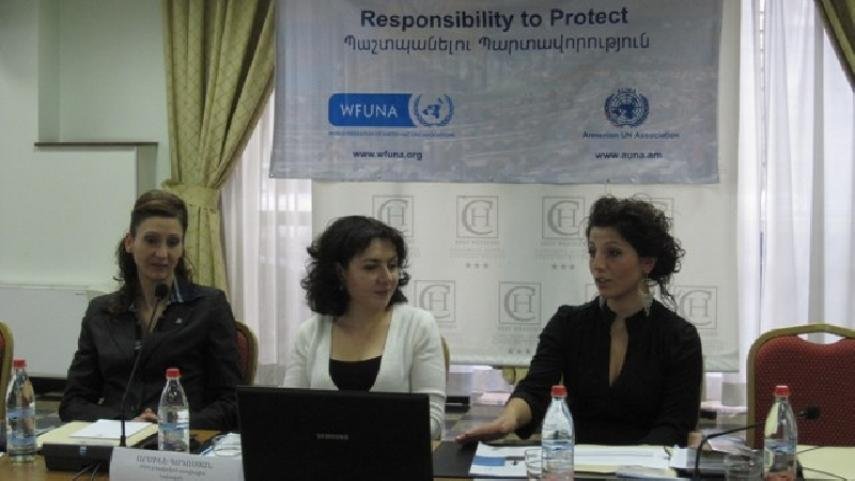
World Federation of UN Associations realizes "Responsibility to Protect: Uniting Public and Political Will" program, and UN Armenian Association joined it in April of this year. Currently this program is realized in Armenia and Democratic Republic of Congo, however, other countries will also join it in the coming years.
"Why particularly Armenia? I think because Armenia, having such historical precedent, should be the first to demand prevention of such crimes and protect people. How can we be indifferent, when in Rwanda, Darfur, Cote d'Ivoire such crimes are happening? We demand the world to accept our genocide, which happened 100 years ago, therefore we can't be indifferent to crimes happening today", says the president of UN Armenian Association Armine Podosyan.
According to her, R2P norm is often interpreted in wrong way, stressing the third pillar which allows international community to intervene the interior affairs of the country. However this norm primarily has preventative nature: "The whole meaning of this norm is in its first and second pillars, i.e. prevention and responding in time in order the problem didn't get to its third phase-intervention. This means that states should first of all protect their civilians from violence", stresses Podosyan, adding that the decision of intervention is made by UN Security Council.
According to her, after 2009 more states approved R2P, since it was presented correctly. "R2P" national coordinator Amalya Grigoryan brought Libya's example as intervention.
She mentions that though the Media covered events and the situation in the Middle East, they are not aware of R2P norm. "There was mainly copy pasted news. The news was neither of investigative, nor analytical type", she says.
According to Amalya Grigoryan the main aim of the program is to raise awareness on this norm. She highlights the role of civil society in the realization of R2P since "if there is problem of preventing crime, NGOs are first to react".
Three year program will include trainings, political discussions, spreading the information and coverage by the media which will be aimed at raising the awareness of R2P.
The national coordinator of the program is convinced that awareness is the tool which will indirectly result in the raise of level of protection of people's right to life.
Mary Alexanyan
Source: www.hra.am