
NON-GOVERNMENTAL ORGANIZATION


Research on Religious Tolerance
There are manifestations of violation of freedom of conscience and religious discrimination in different spheres of public life of Armenia. The Collaboraton for Democracy Center and the Organization for Security and Cooperation in Europe Yerevan Office have carried out research of such cases.
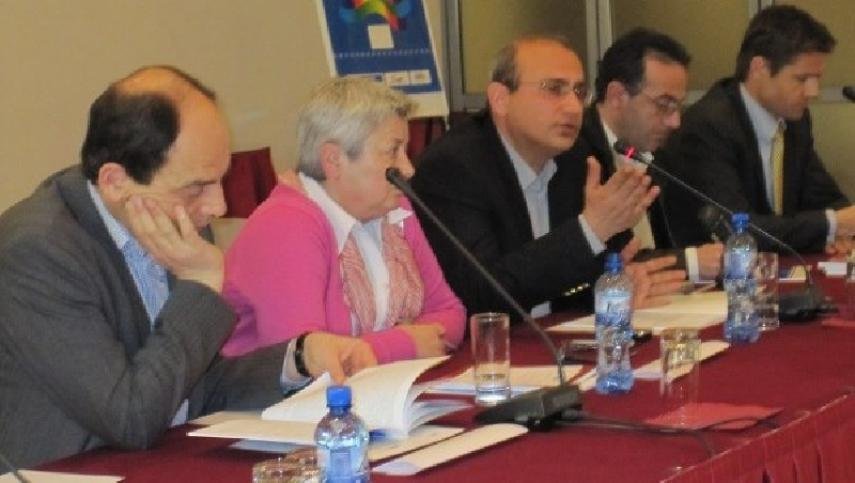
Today at Ani hotel "Religious Tolerance in Armenia" report was presented to the representatives of non-government organizations, different religious communities and media outlets.
There was no debate or at least discussion since no representative of the Armenian Apostolic Church or National Assembly deputy was present. Nevertheless, those present touched upon the current state of things in Armenia from the viewpoint of religious intolerance raising some of its reasons.
Stepan Danielyan, co-author of the research, thinks that religious intolerance has its grounds. Among them he marked out the role of mass media that very often pour oil on the flames and carry out anti-propaganda against many religious communities. Besides, the research has shown that the legal field with its imperfect laws plays an important role in disseminating intolerance.
In particular, the speakers unanimously marked out the draft law on making amendments in the "Law on Freedom of Consciousness and Religious Organizations" passed in the National Assembly in the first reading that has provisions limiting activities of religious communities. The research also touched upon those provisions.
"There are historical cultural values in Armenia that are consigned to oblivion by Armenian Apostolic Church. They are spiritual buildings of Chalcedonian period. So we are intolerant also to our past," Stepan Danielyan, Chairman of the Collaboraton for Democracy Center, emphasized.
Ethnographer Hranush Kharatyan thinks that our historical experience, our religious past is not explored.
"Today they even want to take out from the curriculum the Paulician movement labeled sectarian that was included in textbooks back in the Soviet period. Whereas such historical realities allow the society make independent judgments about its own past." The ethnographer believes that students in schools should be taught theory of religion and not religion.
Mrs. Kharatyan thinks the attitude of the society to other religious communities gradually becomes more tolerant. Moreover, she says that relations between neighbors professing different religions continue to be in the humane domain.
Larisa Minasyan, Director of the Civil Society Institute, was of the opposite opinion presenting a remarkable episode from the research carried out by their institute.
"The research was carried out among young people. Answering the question "Would you like your neighbor to be member of another religious community, a thief or a drunkard?" 80% preferred the second and the third versions to the first one."
According to Arthur Sakunts, human rights activist and head of the Helsinki Citizens' Assembly Vanadzor Office, there are many cases indicating of religious intolerance in Lori province:
"The principal threatens to "check" the students in the school to find out what religious organization they belong to; then he announces that things will not be good for those who are not followers of Armenian Apostolic Church. And this is the principal who was openly campaigning for one candidate during presidential elections."
Avetik Ishkhanyan, President of the Armenian Helsinki Committee, marked out one salient episode from the report relating to the posters "Death to Sects and Sectarians" signed and posted in different parts of the city by Armenian Race Worshipers.
"My advice to such organizations would be to take into consideration their names. Race worshipers aren't likely to be Christians. Then why are they propagandizing against other communities? Propaganda is a powerful weapon, it gives rise to intolerance, and Jehovah's Witnesses are among the first "witches"," Ishkhanyan said.