
NON-GOVERNMENTAL ORGANIZATION


Gaps in Legislation on Media: the Experts Call to Simplify the Licensing Process
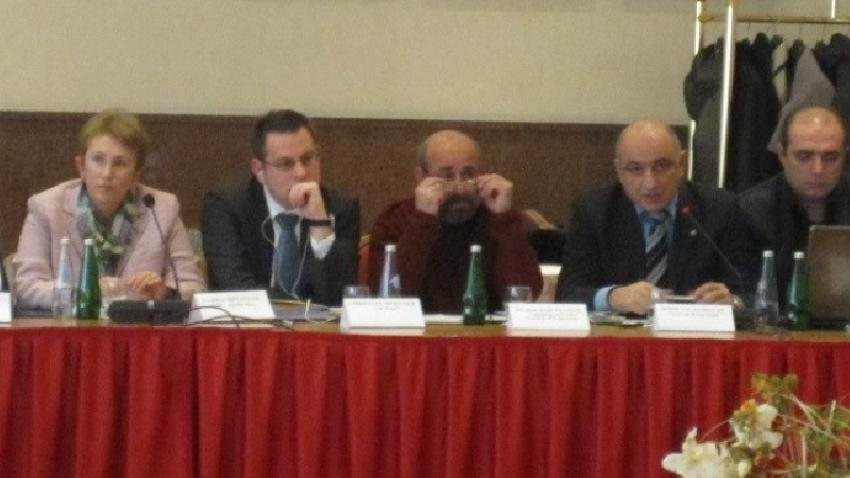
At the conference entitled "Mass Media in Armenia: 2010 Reflections and Trends for the Future" held on January 27, 2011 the existing gaps in RA legislation regulating media and problems of freedom of media were discussed.
The organizer of the event is "Partnership for Open Society" Initiative in cooperation with the Yerevan Offices of OSCE and Council of Europe.
"OSCE Office in Yerevan has been closely monitoring the alleged cases of violence and intimidation against media professionals liaising with the law enforcement on this issue. We have been stressing that the disclosure of those standing behind these crimes will help prevent other such acts in the future and the chilling effect they may have on the journalists and media", said Sergey Kapinos, ambassador of the OSCE Office in Yerevan, in his opening remarks.
The Armenian and international experts, who reviewed media legislation, have pointed out a number of problematic issues in the law on "Radio and Television" and other relevant legal documents.
Public Council member, lawyer Armen Ter-Tachatyan believes that the principles of formation of the National TV and Radio Commission and the Public Council should be revised, the process of licensing should be clearer, reasons for allocation and denial of broadcasting licenses should be well-founded and presented in written form, attention should be paid to the linguistic issues, advertisement etc.
Expert of the Committee to Protect Freedom of Expression Mesrop Harutyunyan said that the authorities are always striving to control the most massive mass media - TV. This is the reason why the tender for broadcasting license is always politicized.
The expert highlighted the necessity to promote a simple process for licensing that will imply submission of application to the relevant body, obtaining the license, selection of broadcasting means (cable, satellite etc). Besides, the National TV and Radio Commission may announce a tender on communicational means every 10 year for TV companies that have obtained broadcasting licenses.
Mesrop Harutyunyan believes that the public awareness is another important issue. People do not understand what digitalization implies and what they can expect in 2015.
Director of the Media Law & Policy Centre, Professor and Head of the Media Law Department, Faculty of Journalism of the Lomonosov Moscow State University Dr. Andrei Richter says they are ready to support Armenia in bringing mass media sector in compliance with the European standards.
According to Dr. Richter, the main problem is that the model regulating the broadcasting is not clear and not transparent and maybe interpreted differently. These kinds of laws do not comply with the principles of democratic state. He believes that one of the reasons for legal gaps is the fact that Armenia has not joined the European Convention on Transfrontier Television.
"After digitalization in the European countries the number of TV channels increases. However, the situation is visa versa in Armenia", says the expert. He added that all the issues and ideas should have been discussed in details before the process had begun.
Consultant of the organization Information society, expert of the Council of Europe Christian Muller supports this opinion. He stresses out that all interested parties should have been involved in the discussion.
Licensing body should have independency from the state, termination of the license should be considered as the means of last resort and the law should prescribe also other softer sanctions. These were issues presented in the Council of Europe expert's report.
Special Representative of the Secretary General of the Council of Europe to Armenia Silvia Zehe is convinced that the analysis elaborated by the international experts may bring significant improvement to the existing media legislation.
Chairman of Journalists' Club "Asparez" Levon Barseghyan spoke about the content regulation of the mass media. National TV and Radio Commission and the Public Council have developed Ethical standards for broadcasting companies. These standards do not have clear definitions and wording. Besides, implementation of the standards is not controlled by any of the existing bodies. There is no known single case that any TV company was charged for breaching those standards. It allows Levon Barseghyan to state that the process of content regulation was failed.
Journalist of «Aravot» daily Anna Israelyan, Chairman of the Committee to Protect Freedom of Expression Ashot Melikyan and lawyer Artak Zeynalyan presented the reports on freedom of speech, violation of rights of journalists and recently conducted broadcasting license tender.
Anna Israelyan who covered broadcasting licensing and frequency tenders stated that there was no competition in the reality. Everything developed according to the previously planned and agreed scenario.
Artak Zeynalyan reminded that the decision made by the European Court of Human Rights regarding «A1+» TV Company is not implemented by the Armenian authorities so far. The lawyer thinks that the best solution is to grant the frequency to «A1+» without competition.
Ashot Meliqyan has stressed out that compared to the previous year, violations against journalists decreased. However, when the political situation is sharpening, particularly during the elections, the number of violations increases.
The reports were discussed; many issues and problems were raised. A suggestion was made to limit powers of the National TV and Radio Commission.
Mary Alexanyan
Source: www.hra.am
Source Url: