
NON-GOVERNMENTAL ORGANIZATION


Freedom of conscience and religion: discussion in Kapan
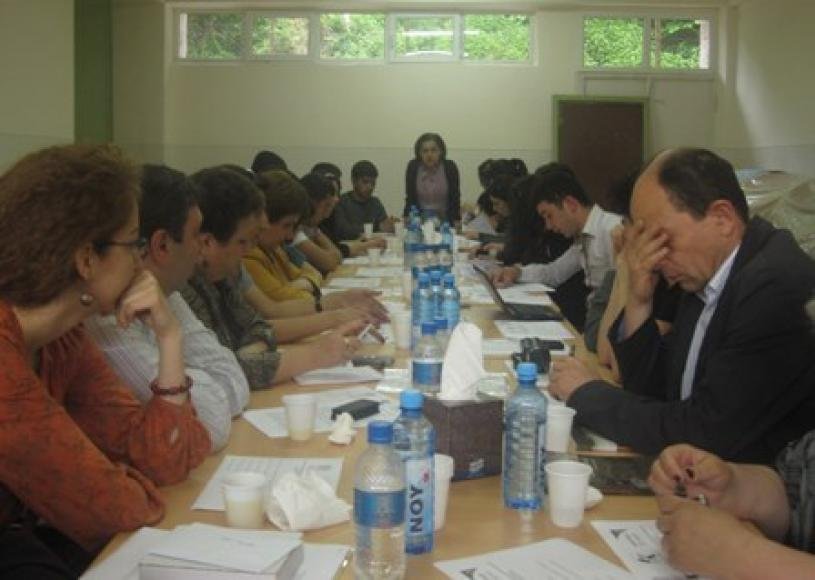
Edgar Hayrapetyan from Kapan suggests that the law should prohibit parents from exposing their minor children to this or that religion, and that it should define the responsibility for violation of this principle. This suggestion was declared by Edgar during the discussion on freedom of conscience and religion, held on 15 May in Kapan.
“It is clearly stated in the law that we should not struggle against religious organizations, but being Christians we want to struggle. There is one option to that, let people have a right to decide on their faith when they are grown ups”, says student Edgar Hayrapetyan.
The youth of Kapan mainly expressed their negative opinion on religious organizations, dissatisfied with the facts that they freely go and visit people's home, do not want to serve in army, do not allow to blood transplantation in case of necessity.
Avetik Ishkhanyan, president of Helsinki Committee of Armenia first reflected on the question, that there is no such a word as “sect” and in Armenia it is used to bring a negative meaning to the phenomena.
“Not serving in army is a serious problem, but there are two types of people who do not serve in the army in Armenia, people who escape military service and people who object military service. The objectors are Witnesses of Jehova: they do not bring in certifications that they are mentally ill, do not bribe and they become released after three years of imprisonment. 70 people imprisoned stay in 20 sq.m. room,” says Ishkhanyan.
Ishkhanyan proposes to work on legal regulation of alternative service, which is successfully implemented in many civilized countries.
Student Avet Avetisyan noted that if there were no other religions, the Armenian church would lose its role, as there would be no body, against which there was a need to struggle. Present at the discussion priest Ter Shirak mentioned that they respect human rights and also understand the mission of the Armenian Apostolic Church fixed in the RA Constitution.
“The God gave a freedom of choice in the heaven to taste fruit of all but one tree. After that, he gave the man a free will to choose freely what is divine, this or that religious organization, political status, and this freedom is very good and positive. There is a question here, how do we perceive this freedom, do we perceive is as all- mightiness or in other ways,” believes Ter Shirak.
A teacher Araksya Movsisyan suggested that the curriculum have programs providing information about the Apostolic Church.
The discussion gave an opportunity to participants to share their opinions and look at the issue from different viewpoints, in the context of the RA Constitution, human rights and tolerance.
The discussion on freedom of conscience and religion was organized by the Kapan Area Development program of World Vision Armenia within the framework of "Grassroots Voices for Human Rights Mobilization in Armenia" project.
Source Url: