
NON-GOVERNMENTAL ORGANIZATION


The Criminal Cases Against Attorneys Will Be Terminated
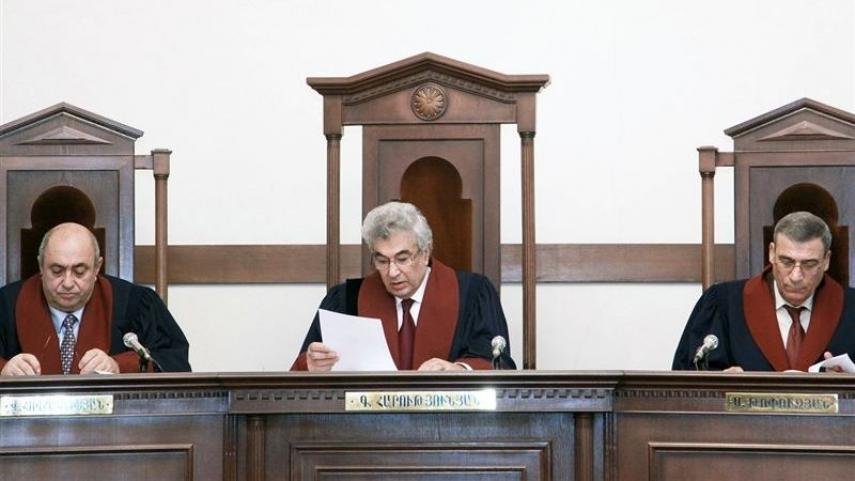
On January 14, 2010 The Constitutional Court of Armenia found that Article 343 part 1 of the Criminal Code of Armenia contradicts part 1 of Article 14.1 and part 1 of Article 19 of the RA Constitution and recognized it invalid. Based on this decision the criminal persecution of defense lawyers who were accused based on the mentioned Article "for the contempt of the court" will be finished.
After Presidential elections in 2008, particularly after March 1 events this Article became more significant and started to "punish" particularly the attorneys.
Armen Harutyunyan mentioned in the application submitted to the Constitutional court on last June, that part 1 of Article 343 "has created conditions for uncertainty, biased interpretation and enforcement", and on the basis of this questionable norm, criminal cases were brought towards a number of attorneys.
The defender's application was not based on the issue of defining as criminal responsibility or not defining it, but to the issue to enforce this provision equally to both parties of the criminal proceedings. The problem is the defendant; witnesses and the victim are held responsible for the contempt of the court and not the prosecutor. Armen Harutyunyan asked the Constitutional court to eliminate this unequal approach. RA Chamber of Advocates have also applied to the Human rights defender with the request to apply to the Constitutional court.
We would also like to remind that attorneys Ara Zakaryan, Artur Grigoryan, and Diana Grigoryan during the trial of the case of "Pizza De Roma" as a protest against illegal actions of the court had left the court room, which was considered as a contempt of a court, and caused criminal proceedings against them. Likewise behavior was adopted by attorney Mushegh Shushanyan, who had protested against the illegal actions of the court during the trial of active representative of opposition Vardges Gaspar. The people who had committed the offence envisaged by part 1 of this Article are punished with a fine in an amount of 100 minimal salary or with a detention for up to 1 month.
Up to 2006 contemptuous attitude towards the court was considered as administrative offence, and was punished by a fine. Since 2006 the approach towards "contemptuous attitude" became more serious and was criminalized. The case brought towards the advocates was heard by judge Mkhitar Papoyan in the court of first instance of Arabkir and Qanaqer-Zeytun communities.
Even though dates for court sessions have been defined, they have been postponed because of different reasons, and the case has not entered the stage of court proceedings yet. After a number of motions submitted to the court by the defense attorneys judge Mkhitar Papoyan
accepted the last one and expressed self-rejection.
"By this step the judge set himself aside. He did not want to administer judicial proceedings by this case and make a decision. All of us understood, and for us it was quite clear that if the case continued, there would be no possibility of acquittal and only accusatory decision could be expected. According to Aramazd Kiviryan judge Mkhitar Papoyan tried not to make an accusatory decision himself. For the accused attorneys decision of the Constitutional court was surprising.
"We hoped that this norm will be considered unconstitutional, but we also had some suspicions that some pressured could be imposed on the Constitutional court, since pressuring the attorneys was not accidental, however Constitutional court found power. Bringing a criminal case towards the attorneys is a step of humiliating the role of the attorneys, a punch on the Attorney's institute and the profession of an attorney", said the attorneys after the decision of the Constitutional court.
The courts will have to terminate criminal cases against four attorneys. CC decision comes into force since its publication and is final.
After the CC decision the office of Human Rights' defender has disseminated an release about the victory in the Constitutional court.