
NON-GOVERNMENTAL ORGANIZATION


The results of a study on disciplinary isolators and disciplinary battalion under the Ministry of Defence were presented
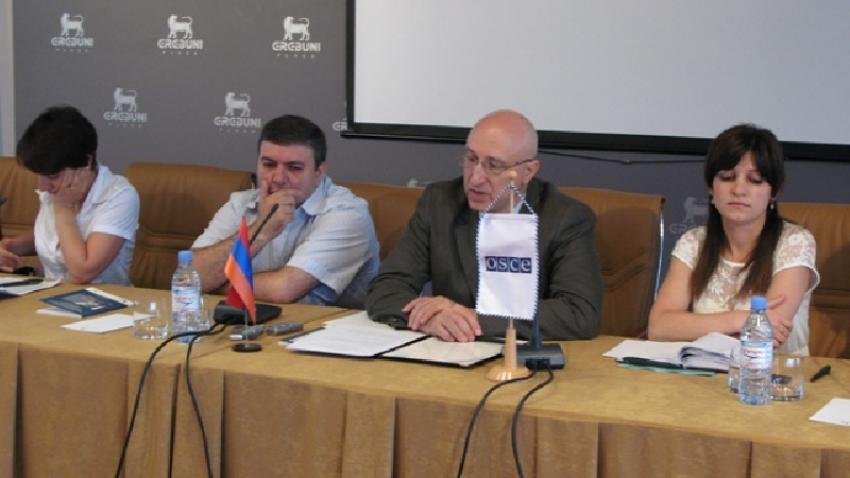
The results of a study on the conditions of persons deprived of their liberty in disciplinary cells and disciplinary battalion of the Armenian Defence Ministry were the focus of a discussion organized in Yerevan on July 20.
The study was conducted in 2009 by the Civil Society Institute NGO in co-operation with the Defence Ministry and with the support of the OSCE Office in Yerevan. The monitoring team visited all disciplinary cells and the penal battalion, observed the conditions and treatment of persons deprived of their liberty, reviewed relevant legislative acts and suggested a number of recommendations.
Study results demonstrated that the conditions in isolators vary. It was revealed that repair activities were being undertaken in the isolators during the last years; in particular, 7 out of 11 visited isolators were repaired. The repaired isolators meet general standards and ensure similar living conditions. The sanitary-hygienic conditions of the repaired isolators may be characterized as satisfactory, whereas the isolators which were not repaired have rather poor sanitary-hygienic conditions. It is worth mentioning especially the isolators located in Vedi, Gyumri and Echmiatsin where it will be impossible to ensure acceptable conditions for the persons deprived of their liberty even after the repair.
The results of observations revealed a number of systematic problems in connection with the practice of imposing isolation as a disciplinary sanction. They mainly refer to permissibility of application of isolation as a disciplinary sanction within the context of the right to liberty of armed forces personnel, legality of its imposition without proper examination, broad application of disciplinary isolation sanction irrespective of the severity of misconduct and level of guilt, setting of a possible maximal term in case of application of disciplinary isolation sanction and application of different means of the sanction for the same misconduct.
The analysis shows that the procedure of imposing the sanction of disciplinary isolation as stipulated in the Disciplinary Statute does not comply with international standards. This level of normative legal regulation fails to ensure the practical implementation of the international standards and Armenian constitutional guarantees deemed mandatory in imposing a disciplinary isolation sanction.
As a possible solution the following order for imposing isolation sanction may be proposed: isolation of up to 3 days may be applied upon the commander's decision, while isolation exceeding 3 days shall be applied exclusively upon the court decision. Of course, such regulation will be possible only in case the Constitutional Court gives a broad interpretation to Article 16 of the Constitution and the expression "sentencing for a crime" is considered by the court as "sentencing" for other types of misconduct as it is interpreted by the European Convention on Human Rights.
It is also necessary to develop a special procedure defining the requirements in the examination of cases on application of disciplinary isolation sanction as well as the guarantees to be observed during examination of such cases.
On the other hand, the studies showed that even the current imperfect procedure of imposing a sanction is not observed in practice. Particularly, it turned out that in practice examination is not conducted, whereas according to the Disciplinary Statute the commander (chief), must perform an examination and find out whether the misconduct was committed, when, where and in which circumstances it occurred, the type of misconduct, the presence of guilt in actions or inactions of certain persons, degree of guilt of each person if it was committed by several persons, consequences of the misconduct, mitigating and aggravating circumstances, reasons and conditions in which it was committed. Implementation of the examination is а legislative requirement, while its absence violates the presumption of innocence and may lead to unduly sanctions by the commander, adoption of wrong decisions and increase the probability of imposing disproportionate punishment for the misconduct and even punishing of innocent persons, whereas the only warranty of upholding the military discipline is the implementation of fair, lawful and effective policy of holding responsible persons accountable.
With respect to the disciplinary battalion, the study demonstrates that one of the most important problems related to the disciplinary battalion is the issue of improving building conditions. They are extremely poor; the structure is not typical, the building has no foundation, as a result the walls are extremely wet. The current repair works are unproductive, and the study revealed the urgent need of providing or constructing a new building for keeping the convicted persons.
At the same time, it should be underlined that the legal regulation of the conditions and serving a sentence in the battalion is better. Perhaps two problems may be singled out among the legal issues.
First, from personal hygiene items the battalion provides the convicts only with soap. This gap stems from the fact that the conscripts receive salaries and buy personal hygiene items with their money, whereas the convicts receive neither salary nor are provided with hygiene items. Convicts are provided with necessary items either by their friends/relatives or the administration of the entity on their personal means. Such provision creates unequal conditions for the convicts kept in the disciplinary battalion as compared to other convicts. Therefore, it is necessary to envisage a provision on sanitary-hygienic items for convicts in the budget as it is practiced in penitentiary institutions.
Second, long-term visits are not envisaged by the legislation for the convicts kept in the disciplinary battalion. This creates unequal conditions for the convicts kept in the disciplinary battalion as compared to other convicts and allegedly aggravates their punishment. In the penitentiary system convicts have a right to long-term visits. As the experience shows, it contributes to upholding contacts with the family and has a positive impact on moral-psychological state of a convict.
Based on the results of the study, in order to improve the conditions of keeping persons subjected to disciplinary sanction, arrest and detention, as well as those subjected to punishment in the form of detention in the disciplinary isolators, on the basis of the Disciplinary Statute of the Armed Forces of the Republic of Armenia, and the conditions of serving sentence in the disciplinary battalion it is recommended to:
- Establish uniform conditions for keeping persons subjected to disciplinary sanction, arrest and detention, and those subjected to the detention as a form of punishment, as well as those kept in the disciplinary battalion. These uniform conditions should meet the minimum standards envisaged in the European Prison Rules, in particular,
- Provide all persons subjected to the disciplinary isolation sanction with beddings;
- Eliminate the allegedly discriminatory norm envisaged in the legislation which prohibits smoking for soldiers during isolation as compared to the corporals;
- Ensure the opportunity for taking a bath at last 2 times per week as envisaged in the European Prison Rules;
- Provide cells with comfortable stools which are placed next to the tables;
- Exclude opportunities for keeping persons incommunicado. Create an opportunity for establishing correspondence with the relatives, making phone calls and visits, including receiving news and information from the outside world;
- Ensure the opportunity for the persons deprived of their liberty to open cell windows independently;
- Develop a mechanism for permanent access to drinking water which excludes applying to the staff for a new portion of water;
- Place benches in the walking areas and cover them by tents for protection from precipitation;
- Allow the persons deprived of their liberty to use the toilet without any limitations. For example, to place isolated toilets in cells as it is practiced in the penitentiary system;
- Exclude cooking of meals in isolators as long as there are no special conditions and items for cooking. Current conditions of cooking and food provision do not comply with the RA sanitary and hygienic rules and norms established for food supply;
- Gasify the isolators which will enable to heat the entities efficiently, by ensuring adequate temperature. It will also enable to significantly save the financial resources of the state;
- Allocate a new building that complies with the contemporary standards for keeping persons deprived of their liberty in the disciplinary battalion;
- Envisage a legislative provision for long-term visits for the convicts in disciplinary battalion which will promote keeping of contacts with the family and have positive impact on moral-psychological state of a convict;
- Provide convicts kept in the disciplinary battalion with sanitary-hygienic items as practiced in the penitentiary institutions.
At the same time, to improve the practice of application of disciplinary sanction and to bring it into compliance with the RA Constitution, we recommend to:
1. Avoid applying the sanction of disciplinary isolation as long as there are no legislative provisions and mechanisms which comply with Article 16 of the Constitution.
2. Comply the practice of application of isolation as a disciplinary sanction with the requirements of Article 6 of the European Convention, i.e. to apply isolation exclusively upon the court decision.
3. Develop a special procedure establishing the requirements of the examination of application of isolation as a disciplinary sanction as well as the guarantees to be observed during examination of these cases.
4. Clearly identify the list of misconducts, as a result of which the conscripts can be subjected to isolation as a disciplinary sanction. Ensure adherence to the requirements and standards of Article 6 of the European Convention during the examination of such misconducts, including examination of a case by an independent court, ensuring equality of arms, provision of adequate time and facilities for the preparation of the defense.
5. Perform examination of misconducts, for which other sanctions than the isolation is envisaged, according to the current procedure guaranteeing factual performance of examination.
6. Adopt a substantiated decision on the application of the sanction of disciplinary isolation, where the facts of the specified misconduct, legal grounds for the application of the sanction will be mentioned, as well as justifications about the type of the selected sanction, and in case of choosing a sanction of keeping in isolation - also reasoning why the application of other sanctions is deemed insufficient will be specified. The substantiated decision should contain a note on appeal procedure, and a copy of the decision must be provided to a party subject to the sanction.
7. Unify the practice of application of disciplinary sanctions and exclude manifestations of random selection of sanction.
8. Develop a procedure ensuring effective implementation of the right to appeal the decision on application of the disciplinary sanction.
The full text of the report in Armenian is avialable at the following link:
Disciplinary cells_report.pdf (Armenian, pdf, 550 kB)
Source Url: