
NON-GOVERNMENTAL ORGANIZATION


Lumbering in Armenia. The Right to a Healthy Environment, Problems and Solutions
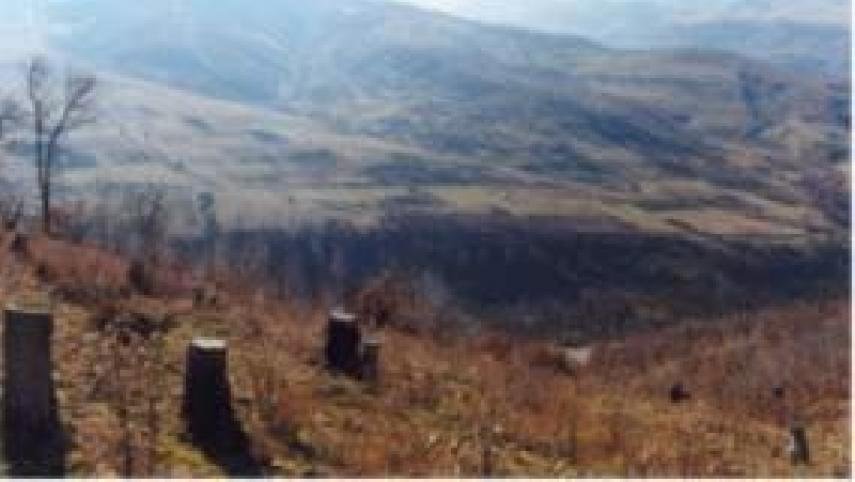
After the collapse of the USSR, Armenia faced a number of problems - social, economic and political. Continuous clashes with neighboring Azerbaijan as well as Turkish-Azeri blockade finally resulted in energy crisis. As a result due to the lack of gas and electricity people started to use trees for fuel. Illegal lumbering became widespread. According to the data of International Forestry Review of 2005, only in 1991-1996 about 600,000 cubic meters of trees were cut annually in Armenia. The lumbering did not stop during the next years: it is testified by the data registered in 2005 that forests covered 10% of the territory of RA in 2005, whereas in 1988 the number was 11.2%1.
What is the state of the things today? Do illegal lumbering continue today when there is no energy crisis and according to RA Ministry of Trade and Economic Development only in the first 6 months of 2005, 10.2% economic growth was registered?
According to the data posted on the website of the Armenia Tree Project (ATP) the situation is as follows: today about 750,000 cubic meters of trees are cut annually on the territory of RA. According to experts this will result Armenia's desertification in 50 years. Accordding to the research about half a million cubic meters of wood is burned annually in Armenia and only 10-12% of it is registered. Due to such illegal activities not only the green territories of Armenia have reduced, but also structural changes in tree species have occurred: high value trees such as beech, oak, pine, and ash have been replaced with low efficiency species (such as fennels). (United Nations Common Country Assessment of Armenia).
According to another research by ATP, more than 100,000 hectares of forestland was cut on the whole territory of Armenia since 1993. As a result today Armenia has 240,000 hectares of forests which is 8% of the whole territory (Armenia Tree Project).
Finally, according to another research by UN, 24.353 square kilometers of the territory of Armenia, which makes 81.9% of its territory (excluding territories of the Lake Sevan and other reservoirs), is subject to desertification to different extents. There is an extremely high threat of desertification for 26.8% of the territory, and a milder but still possible threat of desertification for 8.8% of the country's territory2.
What are the official data and generally the position of the state in this question?
Let's first mention that according to official data, forestland in Armenia covers 334,100 hectares, i.e. 11-12% of the territory of RA. However, these numbers date back to 1992. According to the above research, today forests cover 8% of the RA territory.
According to Martun Matevosyan, director of "ArmForest" SNCO3, forests have undergone qualitative changes, but forestlands have not reduced. He states that now forests cover the same territory as in 1988. Comparing with 1988 and 2006, mainly in the Tavush and Lori regions, forest resources have not reduced, the level is the same despite big volume of felling. Mr. Matevosyan claims also that forests grow and in logged areas the natural increment is faster.
At present a project of improving the forest legislation and forest sphere management is being implemented in the European Neighborhood Policy's eastern countries and Russia supported by the World Bank, International Union for Conservation of Nature (IUCN) and World Wildlife Fund (WWF). ArmForest, in its turn,puts much effort in making the population more informed about the penalties for illegal tree felling.
As for the existence of tree felling business in Armenia, Mr. Matevosyan believes such business is not established in Armenia. Moreover, he thinks it is the objective of ArmForest and the country to establish it as a business - cutting, transportation and utilization. Mr. Matevosyan hopes that after approving these forest management plans they will move in that direction and the state will invite tenders. But Inga Zarafyan, head of "Ecolur" environmental NGO, considers any cutting to be an irreversible loss. "Business has to be pushed out of this sphere," Mrs. Zarafyan states. The authorities, however, do not agree with her, claiming that it may become a heavy burden for the socially vulnerable population living in forestlands who hope to get fuel and jobs at the expense of forests4. The solution that offers Inga Zarafyan is, e.g. carrying out "no tree felling policy" for 5 years, banning logging and also reducing gas prices for people living near forests. She insists that it will cost the government cheaper than solving the problems caused by fellings. She says that when they raise alarm about forest cuttings, their activists are called to the police and interrogated there. "It is not our objective that the poor forest warden, who is executing an order, is put into prison, our objective is correcting the situation," Inga Zarafyan says adding that in Hankavan 500 hectares of trees has been taken out of forest territories and has been given to the communities, which sold them to unknown persons5.
Minister of Agriculture Gerasim Alaverdyan has his solutions for tree felling problems. During his visit to Vanadzor, where he met representatives of law-enforcement bodies and forestry experts of Lori region to discuss reasons for illegal cuttings and means to prevent them, the Minister announced that in the nearest future check points would be installed, which would control trucks coming from the forests, which will help to reduce the volume of illegal cuttings. Besides, last year a project was developed in the Ministry of Agriculture intending to provide cheap firewood to the population living near forestland. If now they pay 1200 Drams (~ 4$) for 1 cubic meter of firewood, after the decision is approved, they will pay 600 drams (~ 2$).
The third step that is supposed to prevent illegal cuttings is improving labor conditions of forest wardens. At present their salary is less than 50,000Drams (~ 137$), they have no weapon, no car or horse and no uniform 6.
Judging from the programs mentioned by the Minister of Agriculture, one can suppose that forest cutting may be reduced, but it will not stop. But aren't the figures brought by experts stating that 24,353 square kilometers of the territory of Armenia, which makes 81.9% of its terrotiry (excluding territories of the Lake Sevan and other reservoirs), is subject to desertification to different extents (UN), enough to become a powerful incentive to stop forest cutting at least for several years?
According to a research carried out by the Armenian Center of Ethnological Studies in 2009, forest cuttings will not be possible to stop even for one year as long as gas is inaccessible for remote forestland villages not due to geographical factors but because of its high price. The research carried out in Syunik, Tavush and Lori regions have showed that wood is used as fuel not only in the areas that have no gas, but also in areas with gas, and the volume of gas consumption as fuel has considerably decreased parallel to the increase in its price. "Gas is used in case of emergency or e.g. to heat some room. Along with gas wood is used as fuel," ethnologist Hranush Kharatyan says.
So in this case Inga Zarafyan's proposal of making gas more affordable for inhabitants of remote forestland villages seems a possible solution for the problem.
However Hranush Kharatyan mentions that forest is more often cut for business purposes, and that the main threat for the forest is not the cuttings for heating but the cutting for business purposes because namely in this case the best trees are cut7.
So another question arises - what should the state do to ban such officially non-recognized, however existing business? Taking into account the above facts and opinions we can come to the following conclusion. Serious supervision has to be secured over all forestland as well as fines have to be raised for each felled tree to the level that will make doing such business unprofitable. Naturally only state supervision will not be enough for ensuring strong monitoring and supervision. Representatives of non-governmental environmental organizations as well have to be involved in the supervision programs to ensure objective and balanced supervision. Only in this case one might be able to speak about reforestation, not deforestation. Before that, the government has to make only one step - get rid of its indifferent attitude towards environmental issues.
- http://www1.american.edu/ted/ice/armenia-forest.htm
- http://www.armeniatree.org/thethreat/facts_figures.pdf
- http://hetq.am/am/ecology/m-matevosyan-2/ 2010/09/17
- http://armenianow.com/hy/social/environment/24966/ environmentalists_suggest_moratorium_forest_logging 28.09.10
- http://hetq.am/am/ecology/antar-3/ 2010/09/28
- http://ecolur.org/hy/news/2010-10-01/1465/ 2010-10-01
- http://hetq.am/am/ecology/antar-3/ 2010/09/28
Sofya Manukyan
Source: www.hra.am