
NON-GOVERNMENTAL ORGANIZATION


Ready to Pay Sign Language Translators
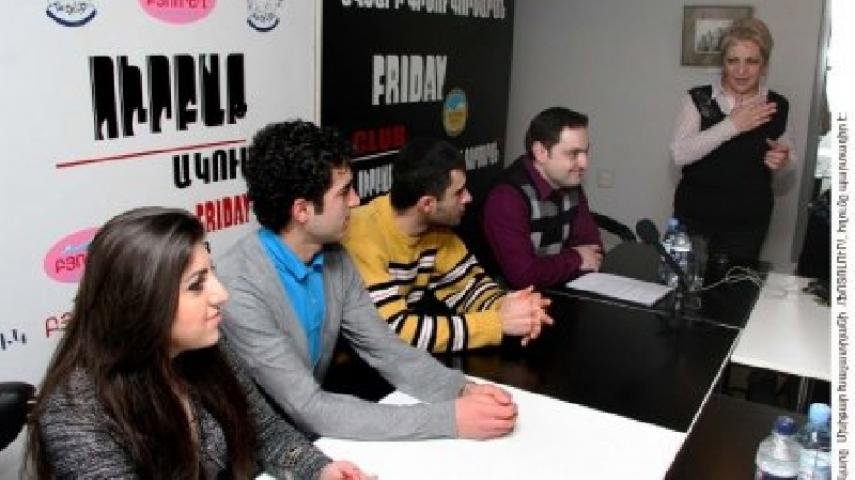
More than 3500 people who have hearing problems are today deprived of their right to get information in their mother tongue - sign language. As a result of the contest announced by the National Commission on Television and Radio (NCTR), ALM TV company which was the only channel providing sign language translation for its programs, was deprived of its broadcasting licence.
The social group of deaf youth "Voice of Silence" wrote a letter to the NCTR Chairman Grigor Amalyan expressing their concerns. In his response Amalyan substantiated the decision by the fact that the state provides school education for deaf children and they can realize their right of getting information by watching programs with the creeping line in Armenian.
"The creeping line is deficient for a number of reasons: it is too fast, letters are too small and the image does not correspond to what is written," deaf youth argue. "To make sure turn of the TV sound, read the creeping line and follow the image."
Vahe Alaverdyan, 18, is the "Voice of Silence" group member. After ALM closed, he and his family do not watch TV at all. "We were looking forward to that news program to know what was happening in the world. Now it is closed and we are disappointed. My peers get complete information and have a chance for choice. I don't have that chance, we are forced to use something that is not convenient for us. I think that my right to be informed is violated and this happens in the 21st century that is considered the century of information. I feel lack of information," Vahe says and adds: "I am deaf but I have no mental problems. I am a full-fledged person; I simply think in the sign language and hear with my eyes. Do you think I enjoy being deaf? If you can't provide a translator for me, give me a chance to hear!"
Anush Davtyan, 22, says that before joining "Voice of Silence" life was dead for her but now she has a chance to express herself and speak out about her problems. She thinks it is unfair that there are no equal conditions for people who can hear and who cannot. "Why should a hearing person have the information and I not? I alsowant to have a chance to develop," Anush says and adds that they can read the creeping line but the thing is that their eyes get tired after reading too much.
"It is very hard for me to be deaf," Artur Karoyan, 28, says. He too is from "Voice of Silence" and does not watch TV any more. He feels sorry for deaf children who are deprived of the chance to watch childrens' programs with sign language translation. "I feel offended by our state and society. I demand that the sign language translator returns to TV," he says.
Zubeida Melikyan is a sign language translator; she teaches at the special school for children with hearing problems and is the author of Armenian dictionary of sign language. She has learned the sign language from early childhood: "My parents are deaf and I'm aware of the problems of the deaf quite well. They get information by their eyes, it is their peculiarity."
She is convinced that providing sign language translation just for two TV programs is not very costly. There simply has to be a wish: "We are ready to pay translators ourselves. We will collect 100 drams from each person and pay the translators."
Twelve members of the deaf youth social group "Voice of Silence" study journalism (with application of new technologies) in the framework of the project "Internet: Equal Opportuniites for the Deaf". The project is implemented by the "Reporters for Future" NGO with the support of foreign donors. "We went close to the deaf to make them closer to all of us," says Suren Deheryan, head of the NGO. He started to learn the sign language to be able to communicate directly with deaf participants of the project. As for now four future sign language translators who study at the Pedagogical University help them to communicate with each other.
"Open your hearts, listen to the voice of silence and you will see that silence too has voice," says Zubeida Melikyan, a sign language specialist.
Mary Alexanyan
Source: www.hra.am